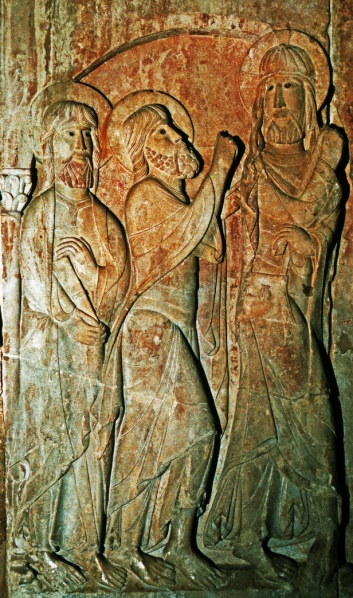
Here are some prompts of what to look for in each of the pictures suggested. They are not exhaustive, for there are as many insights as observers:
The Silos carving
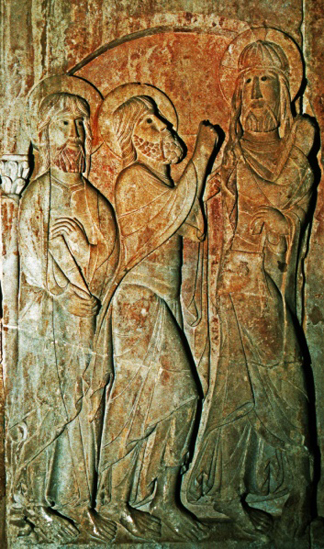
The sculptor dresses the figures in what he supposes to be the clothing of their time; they each have a halo and Christ’s halo bears a cross. He is larger than the other travellers. This is before the breaking of bread; the travellers are on the road, their bare feet all travel the same way, except that Christ’s right foot points back, indicating crossed legs, as though he is turning towards the travellers. Each figure carries a scroll, suggesting a discussion of the Scriptures. The central figure is the most animated, his arm raised in excitement, his right leg bent as though stepping out. The other figure stands back rather more, protecting his scroll with both hands. Jesus wears a bag with a shell on it, always the indicator of a pilgrim in art of this time: Jesus, too, is a traveller. You may see more!
Carravaggio’s 1601 painting
Can we tell who is who? Clothing is mixed: Jesus perhaps in clothing of his time and homeland, the other figures wear contemporary early seventeenth century clothing. Light is used to focus on Jesus as the key figure but also to illuminate the emotions of each of the other characters: what is each thinking? The two seated figures each react strongly: what they going to do next? What is the other figure thinking – and who might he be? In this picture the figure on the right has the shell – the traveller symbol. What is Jesus doing?
Carravaggio’s 1606 painting
Compare this with the earlier painting. Note that it is much darker. The three seated figures are all in ‘biblical’ clothing. Contents of the table are simpler and everyone seems older. Who might the other two characters be? What is the reaction of the seated figures?
Comparing the Carravaggios
Which of the paintings do people like best – and why? How does each painting make us feel? What are the differences and what might they tell us? Read about the differences described in Wikipedia.